|
8.3.2. Ambient Factors
In the past decade, discussions of daylight flying restrictions and on the
potential sensitivity to aviation emissions of specific geographical areas and
flight levels have resulted in research into consequences for the aviation transportation
system of avoiding these areas (Fransen and Peper, 1993; ICAO, 1995; Sausen
et al., 1996). Chapters 2, 3, and 6 of this report describe evolving knowledge
on the possible atmospheric effects of these issues. In general, this scientific
assessment is unable to make clear-cut recommendations regarding possible reductions
in adverse environmental impacts that might be achieved with such flight restrictions.
The description in this section is confined to consequences for the aviation
transportation system.
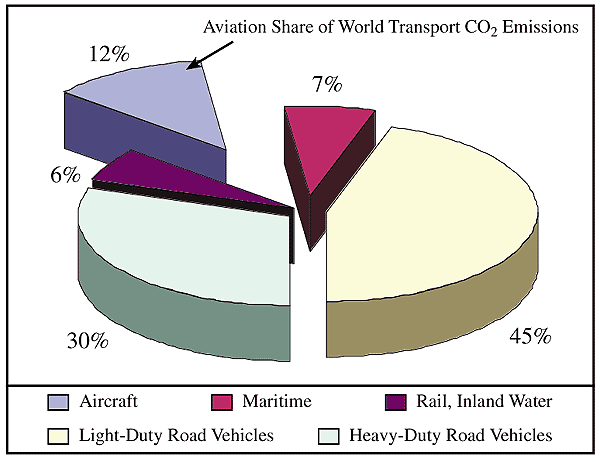
| Figure 8-2: Aviation share of world transport CO2 emissions. |
 |
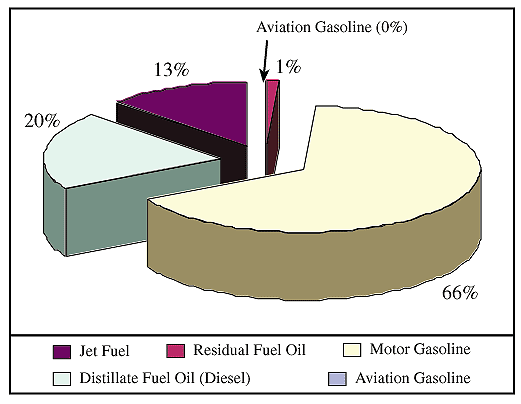
| Figure 8-3: CO2 emissions by transportation mode: United States
- 1996. |
 |
Aircraft operate most efficiently at specific cruise altitude; generally, less
fuel is consumed at higher altitudes, but more engine thrust and equipment may
be required to reach those altitudes. Any requirement to stay, for example,
below the tropopause would undoubtedly increase fuel consumption. In that case,
flights travelling close to the North Pole during the winter would have to descend
to levels that could be 2,500-5,000 m below the most fuel efficient level. Consequently,
fuel consumption would increase for many flights (ICAO, 1995). A study by Fransen
and Peper (1993) showed that total fuel burned by aviation in the North Atlantic
corridor would increase by 4-5% using flight level 310 (approximately 9,500
m) as the maximum allowed level; the increase for an individual flight could
be as much as 20% (Lecht, 1994). This restriction would lead to payload and
range limitations because some current aircraft operate at or close to maximum
range. Such limitations, in turn, could lead to requirements for intermediate
stops-resulting in less direct routes, increased flight times, and increased
fuel burn. Another effect would be concentration of flights, hence increased
congestion, which would contribute to additional fuel burn.
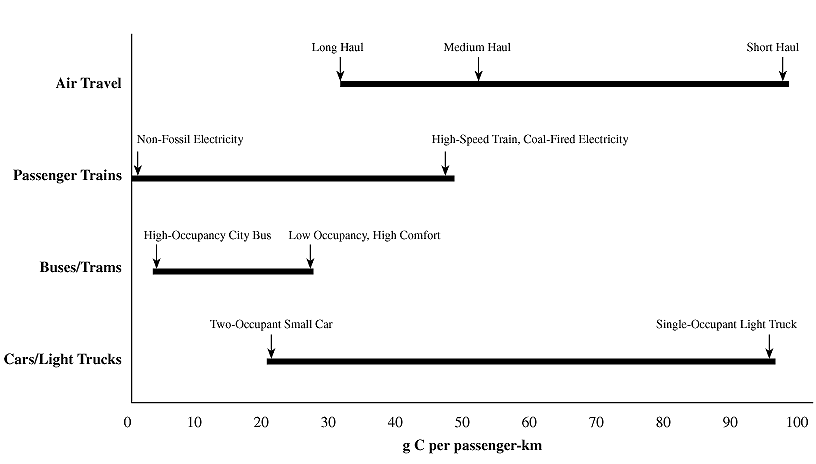
| Figure 8-4: CO2 intensity of passenger transport
(TEST, 1991; Whitelegg, 1993; Faiz et al., 1996; Centre
for Energy Conservation and Environmental Technology, 1997a; OECD, 1997a). |
 |
Limiting flights to specific parts of the day is practically impossible for
a number of reasons, not least because long-range commercial flights can last
for up to 14 hours and during that time can cross a number of time zones. Confining
travel to the hours of darkness would require intermediate stops, which would
result in an increase in the number of landing and take-offs and an associated
increase in the amount of fuel used. An additional problem concerning night
flights is public pressure to reduce these flights for noise reasons.
Table 8-5: Fuel consumption and CO2 production of civil aviation.
|
| |
Total Fuel
Consumption
(Mt) |
Total Fuel
Consumption
(% World) |
CO2
Emissions
(Mt C) |
International Services
Scheduled
Non-scheduled
Domestic Services
United States
Russian Fed.
Other
World Total |
53
10
38
15
17
133 |
40.0
7.5
28.6
11.3
12.8
100 |
45
9
33
13
15
114 |
|
|


