7.4.1.2. Propulsive and Overall Efficiency
The power produced by engine thrust is the product of thrust and flight velocity
(V). The ratio of this useful power to the increment in kinetic energy given
to the flow in passing through the engine is the propulsive efficiency
(hp); a good approximation of this variable may
written in the form hp =
2V/(V + Vj), where Vj
is the jet velocity.
High levels of thermal efficiency require the
T4/T2 ratio to be as
high as possible with appropriate pressure ratio and component efficiencies. In the
case of a simple turbojet gas turbine engine, this requirement would mean that
the jet velocities are also relatively high. For example, for a ratio of
T4/T2 = 5.6 together
with an engine pressure ratio of 40, the jet velocity Vj
would be about 817 ms-1, (Cumpsty, 1997). At Mach 0.85 at 10.7 km, when
the flight velocity V is 252 ms-1, the relationship shown above gives a
propulsive efficiency of only about 47%. Thermal efficiency at this condition is
about 48%, so ho= hp
x htherm = 0.48 x 0.47 = 23% for the assumptions of
this simplified example. For typical aircraft, overall efficiency ranges between
20 and 40%.
The most practical method of raising overall efficiency is to lower the jet
velocity and thereby increase propulsive efficiency; this approach has been
adopted in the bypass engine used so widely today. In this engine design, hot
gases leaving the core turbine expand through further turbine stages, which
drive the fan mounted in front of the core compressor. In most modern engines,
the pressure ratio across the fan at cruise condition is about 1.6, giving a
bypass ratio of about 6 and a jet velocity of about 400 ms-1. At this jet velocity,
propulsive efficiency is about 77% at a cruise speed of Mach 0.85 at 10.7 km.
Unfortunately, losses associated with the inefficiency of the fan and the turbine
driving it inevitably reduce these benefits somewhat, so a typical value for
the overall efficiency of such an engine is currently about 30 to 37% at cruise.
Increasing the bypass ratio clearly offers the prospect of further increases
in propulsive efficiency, but this approach has to be weighed against the penalties
of increased size and weight of the installed engine and associated changes
in drag (see Section 7.2 for further discussion of airframe
efficiency and installation effects). Other prospects for increasing propulsive
efficiency (e.g., propellers and unducted fans) are discussed in Section
7.4.3.
|
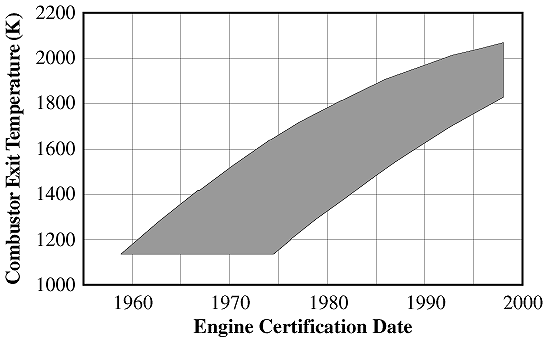
Figure 7-11: Combustor exit temperature trend with time.
|
This brief review of theoretical considerations summarizes thermodynamic and
aerodynamic constraints for engine designers in the continuing drive toward
more efficient engines for current and future requirements. Although today's
most advanced engines have bypass ratios in the range 5 to 9, there will be
efforts to continue to try to increase them. Despite their attractions, however,
bypass ratios much in excess of 9 are likely to require a gear box between the
power turbine and the fan, or a novel configuration (a topic taken up further
in Section 7.4.3), as well as imposing installation and
weight problems.
|
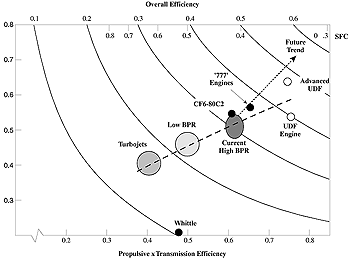
Figure 7-12: Evolution of aircraft gas turbine efficiency
(after Koff, 1991).
|
7.4.2. Historical Trends
The foregoing discussion briefly reviewed the ways in which basic engine cycle
considerations can influence design trends of gas turbines. Practical confirmation
of such trends may be obtained by looking at historical trends of principal
parameters affecting the performance of gas turbines since they were first introduced.
Economic and aircraft range considerations have been uppermost in engine designers'
minds. Figure 7-9 clearly shows the impressive progress
made in reducing thrust-specific fuel consumption (mass flow rate of fuel burned
per unit of thrust) with time. The engines of 1960 to 1970 vintage were either
turbojets or first-generation low bypass ratio turbofans (Figure
7-7) with relatively high levels of fuel consumption. The period from 1970
to the mid-1980s saw the introduction of second-generation turbofan engines,
which are generally referred to as high bypass ratio engines, which had significantly
better fuel consumption than the earlier engines. Improvements in fuel consumption
for third generation engines were smaller.
Important improvements in the understanding of complex aerodynamic flows within
turbomachinery have been achieved over the past 25 years through mathematical
modeling and parallel advances in experimental techniques. Figure
7-10 provides clear evidence of the benefits of that work in the rising
trend of overall pressure ratio with time. In line with the fundamental relationships
presented in Section 7.4.1, this trend has contributed
significantly to the reduced fuel consumption shown in Figure
7-9.
Parallel work in the fields of combustion technology and materials have contributed
to increasing levels of peak cycle temperatures-as shown in Figure
7-11, in which the trend of combustor exit temperature is plotted against
the same time scale. (Note that this is the maximum temperature, which occurs
at take-off. Temperatures are generally lower at cruise.) This increasing temperature
trend has contributed not only to the improved fuel consumption trend shown
in Figure 7-9-by virtue of improved thermal efficiency-but
also to the rise in thrust-to-weight ratio, leading to higher payload for the
same overall aircraft weight. The impact of increasing temperatures on various
pollutant emissions is described in Section 7.5.
|