|
8.3. Other Operational Factors to Reduce Emissions
From an environmental viewpoint, efficiency of transportation ("mobility efficiency")
can be described as the fuel required to transport one person over a distance
of 1 kilometer-the energy required per passenger-km. Comparison of freight hauling
by aircraft to other modes of freight transportation is more complex because
of differences in modes, such as weight restrictions. If various restrictions
to the analysis are assumed and stated, freight may be compared on the basis
of energy use per tonne-km. Because of these complexities and the requirements
of various assumptions, this chapter concentrates on comparisons of passenger
mobility.
Table 8-3: Effect of load factor on fuel burned per passenger-km-Tupolev-154.*
|
Load
Factor (%)
|
Passengers
|
Fuel Burned per
Passenger-km
(kg)
|
MJ per
Passenger-km
|
19
51
70
82
100
|
32
84
115
135
164
|
0.21
0.08
0.065
0.053
0.051
|
8.9
3.6
2.9
2.3
2.0
|
* Based on 164 seats, a maximum payload of 19,100 kg, and
the Bucharest-London Heathrow route (2,235 km). Information provided by
Tarom Romanian Air Transport.
|
The potential to improve the mobility efficiency of air transport is discussed
in Section 8.3.1. The consequences for the aviation
transportation system of avoiding specific areas at particular times and at
particular altitudes and the resultant impact on fuel consumption are described
in Section 8.3.2. Section 8.3.3
compares CO2 emissions from various transport modes. Section
8.3.4 then discusses ground-based, aircraft-related emissions. Section
8.3.5 provides concluding remarks.
8.3.1. Aircraft Performance
This section describes potential reduction of fuel consumption by optimizing
the operational use of an aircraft. Issues discussed include improving aircraft
capacity utilization, reducing the operational weight of an aircraft, and optimizing
the speed of an aircraft. In general, however, these variables have already
been optimized by airlines, largely because of economic pressures and the requirement
within the industry to minimize operational costs.
8.3.1.1. Aircraft Capacity Utilization
The energy required per passenger-km depends on the distance travelled and
the load factor, where the load factor is defined as the ratio between the transported
payload and the maximum payload. Increasing payload improves fuel efficiency,
as illustrated by the effect of payload on fuel burn for a Tupolev-154 (see
Table 8-3). The Tupolev-154 is an older aircraft
with lower fuel efficiency than modern aircraft that is frequently used in the
Eastern part of Europe and the former Soviet Union. The effect of load factor
on fuel efficiency for modern aircraft is similar (see Table
8-4); fuel efficiency of modern aircraft is greater at all payloads (Table
8-4 and Section 8.3.3). For a discussion of trends
in fuel efficiency over different generations of aircraft and levels of technology,
see Chapter 7.
Table 8-4: Effect of configuration on fuel consumption in Boeing
747-400 aircraft.*
|
| |
B747-400 Long-Range
Configuration (262 Seats)
|
B747-400D High-Density
Configuration (568 Seats)
|
| Length of Flight (km) |
Fuel Consumption |
MJ per Seat-km |
Fuel Consumption |
MJ per Seat-km |
1000
2000
4000
6000
8000
10000
12000 |
0.049
0.042
0.040
0.040
0.042
0.043
0.045 |
2.1
1.8
1.7
1.7
1.8
1.8
1.9 |
0.023
0.020
0.019 |
1.0
0.9
0.8 |
*Information provided by Japan Airlines.
|
Apart from load factor, aircraft type, and level of technology, the configuration
of an aircraft (number of seats, distribution between seating and cargo capacity)
also has an important influence on fuel burned per passenger-km. The configuration
is determined by the airline in consultation with the aircraft manufacturer
and can be altered during the aircraft's lifetime. It differs between airlines
and is based on market considerations. An example is provided by the way Japan
Airlines configures its Boeing 747-400 aircraft. The 747-400 in long-range full
passenger configuration has 262 seats, whereas the 747-400D used in high-density
local Asian service has 568 seats, even when used in similar lengths of flights
(see Table 8-4). Seat configuration can also vary
in smaller aircraft. For example, Tarom Romanian Air Transport operates BAC
1-11 aircraft in configurations with 104 economy passengers or a combination
of 12 business and 77 economy passengers. Tarom also operates Boeing 737-300s
with the same operating weights with 12 business and 120 economy passengers
or 20 business and 102 economy passengers.
Most calculations of the mobility efficiency of passenger aircraft do not take
into account the cargo that is carried in aircraft used for scheduled passenger
services. For example, in 1995 about 28% of tonne-km flown by British Airways
operations consisted of freight (British Airways, 1998a), much of which was
carried on passenger aircraft. The United States reported 33.9% for all types
of passenger aircraft in 1996 (Bureau of Transportation Statistics, 1997). The
1996 U.S. cargo load factor for freight carriers was reported to be 61.8% for
all aircraft types. Although relatively little freight is carried on short-haul
passenger service, the carriage of freight might be adding a significant penalty
to the perceived mobility efficiency of passenger air transport for long-haul
flights.
Optimization of aircraft configuration and load factors can result in reduced
emissions. This conclusion is supported by data presented in Tables 8-3
and 8-4. Airline economics dictate that costs, including fuel costs, be minimized,
therefore that the load factor be optimized. As an illustration of the development
of load factors for all domestic and international scheduled services, International
Air Transport Association (IATA) statistics show an average 0.4% per annum increase
in load factor over the past decade (IATA, 1996). These data are consistent
with data in ICAO (1996), which showed an increase in load factor of 4% in a
period of 10 years. However, it is unclear whether the load factor can continue
to grow indefinitely without consequences to passenger service. Moreover, load
factor and aircraft configuration are driven not only by the need for improved
efficiency but also by market considerations.
The increase in demand for air travel is an important factor in aircraft capacity
utilization. (Chapter 9 describes the main drivers for
this increase.) A second important factor is the (further) development of the
"hub and spoke" system in some parts of the world, such as the United States
and Europe. Because transport efficiency is not always optimized by direct point-to-point
travel, air travel has evolved from direct connections between major city pairs
to a complex network that includes consolidation hubs. Costs are minimized by
maximal use of single-sector, out-and-back operations. By combining these sectors
in a hub-and-spoke network, an efficient multiplication of potential point-to-point
markets served can be achieved. Use of the hub-and-spoke system results in greater
distances than direct point-to-point flights; it can also result in fewer aircraft
operations for the entire system. Any area of the world with, for example, 500
airports will have about 250,000 potential point-to-point flights. For many
pairs of airports, however, a direct flight will never occur except where demand
makes direct routes economically viable.
Recent studies (e.g., Peterse and Boering, 1997) have suggested that apart
from further intensification of the hub-and-spoke system, more point-to-point
connections are likely to be introduced. This "hybrid" development arises for
several reasons:
. Two-engine aircraft built for extended twin operations (ETOPS) over water
are available.
. Further segmentation of the air transport market. Business passengers are
prepared to pay more for a direct connection instead of flying via hubs.
. Capacity problems at main hubs are likely to lead to growth at smaller,
secondary hubs.
With the introduction of ETOPS aircraft, a hybrid system will not necessarily
result in a decrease of transport efficiency from an economic point of view.
8.3.1.2. Aircraft Cruise Speed
Historically, the speed of jet transport operations was set at a constant Mach
number. The Mach number is defined as the ratio of an aircraft's speed to the
local speed of sound. The local speed of sound varies with ambient static temperature,
which generally decreases with altitude. The selected Mach number is based on
overall time-variable costs, as well as fuel economy, which has always been
a major component of operating costs. Thus, typical cruise speeds were Mach
0.82 to 0.84 for first-generation jet aircraft such as the Boeing 707, Boeing
727, or McDonnell Douglas DC-8 and 0.84 to 0.86 for early Boeing 747s.
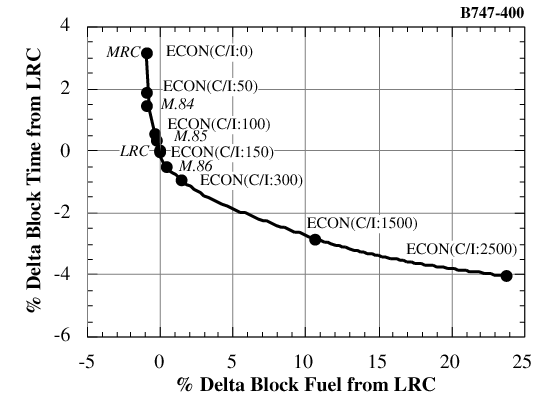
| Figure 8-1: Effect of cruise speed on block fuel and block time. |
 |
Subsequently, a number of fuel-conscious airlines developed the concept of
a long-range cruise (LRC) speed schedule, usually based on Mach number. LRC
was introduced as a compromise between maximum speed and the speed that provides
the highest mileage in terms of km per kg of fuel burned in cruise (maximum
range cruise, or MRC speed), taking some account of costs associated with flight
time. LRC is defined as the fastest speed at which cruise fuel mileage is 99%
of fuel mileage at MRC. At the time LRC was introduced, it was not possible
to fly at lower speeds, closer to MRC, because of the stability needs of the
autothrottle and/or the autopilot. At speeds close to MRC, the autothrottle
would continuously "hunt" which could give rise to an increase in fuel burn.
In the mid-1970s, fuel conservation was further enhanced by development of
the performance management system (PMS) for aircraft such as the Boeing 737
and 747 and the McDonnell Douglas DC-10. Later aircraft (such as most Airbus
aircraft; the Boeing 757, 767, 747-400, and 777; and the McDonnell Douglas MD-11)
included the flight management system (FMS) as a built-in feature. PMS or FMS
computer systems can be used to minimize overall trip cost, which is a balance
between fuel- and time-related costs. The most efficient cruise speed (ECON)
can be calculated on a real-time basis by using the cost index facility on the
system. With full-time autothrottle, late-model aircraft can fly between MRC
and LRC to optimize fuel savings.
Figure 8-1 shows the relationship between the difference
in block time and the difference in fuel consumption for various cruise speed
schedules-such as constant Mach number, LRC, MRC, or ECON-for the Boeing 747-400
(block time is the time between engine start at the airport of origin and engine
stop at the airport of destination; block fuel is the fuel burned in this time).
Data in Figure 8-1 are consistent with those in
Fransen and Peper (1993). The data presented in Figure
8-1 suggest that reduction of fuel use by further speed optimization is
likely to be small.
Bradshaw (1994) investigated the variation in block fuel and block time for
Airbus aircraft. The report shows higher figures (up to 10%) for the potential
reduction in fuel burn from reduction of cruise speed. However, the report also
concludes that reduction of Mach number will involve penalties such as significant
increase in block time and the subsequent effect on direct operating costs.
8.3.1.3. Aircraft Weight Reduction
A negative effect on the mobility efficiency of aircraft can be caused by additional
non-essential weight. Additional weight is introduced if an aircraft takes more
fuel onboard than that required by the fuel flight plan. Tankering is the term
for loading of fuel used for subsequent flight segments. The main reasons for
tankering of fuel are commercial-for example, in cases where the cost of fuel
consumed in carrying additional fuel is more than offset by the difference in
the price of fuel at the departure point and a destination where fuel could
be loaded. Factors that can affect fuel costs and decisions on tankering include
the following:
. Genuine high fuel costs because of expensive distribution infrastructure
and local taxes
. Fuel availability at some remote airports
. Government-imposed fuel pricing (at some Eastern European airports, the price
of aviation fuel is more than 50% more than at Western European airports)
. Monopoly distribution of fuel, which can involve cross-subsidies from large
to small airports and expensive manpower practices
. Concern over fuel quality (e.g., water content) at particular locations
. Slot availability (where limited aircraft turnaround time allows insufficient
time for refueling, an aircraft may have to tanker to minimize the risk of losing
slots; problems in this area are exacerbated at congested airports, where there
may be limitations in runway and/or terminal capacity).
Estimates from British Airways suggest that additional fuel burn as a result
of tankering is on the order of 0.5% of total aircraft fuel consumption.
Apart from tankering, all commercial flights must carry a certain amount of
additional fuel, often mandated by national legislation, for safety reasons.
The minimum amount of fuel required for the planned route is calculated by taking
into consideration the weather forecast, the route, the weight of the aircraft,
and other factors (including an allowance for diversion to secondary destinations).
In most cases, this calculation is carried out with a computerized database.
The pilot is presented with a flight plan and the required amount of fuel, although
the captain decides how much fuel is finally carried. The pilot may adjust the
amount to be loaded in light of any exceptional circumstances and his or her
own interpretation of the risk of diversion or likelihood of weather changes
down the route. The amount of excess fuel carried for safety reasons is likely
to be one to several thousand kg per flight.
Other factors that introduce additional weight are potable water and emergency
equipment. Adjustment of the amount carried to the anticipated requirement,
with a contingency allowance, could accomplish some fuel savings. The extent
to which emergency equipment is carried varies from airline to airline and the
nature of the flight. In addition, aircraft weight is increased by customer
service considerations such as quality of seating, in-flight entertainment,
and duty-free goods.
Although little quantitative data are available, such weight reduction could
result in a potential fuel savings on the order of 1-2%. As described, only
part of this potential reduction can be achieved. Hence, the potential reduction
of total fuel burn from weight reduction is probably less than 1%.
8.3.1.4. Other Operational Issues
During very rare emergency situations, it may be necessary to jettison fuel
into the atmosphere to reduce the overall weight of an aircraft to a safe landing
weight. The potential effects of this (relatively small amount of) jettisoned
fuel are not described here. Chapters 2, 3,
and 6 discuss the possible effects of emitting unburned
aviation fuel into the atmosphere.
Emergencies requiring jettisoning of fuel are mainly mechanical in nature,
such as serious engine malfunction, or airframe structural failure. Severe illness
of passenger(s) is also a major cause of emergency landings. Jettisoning of
fuel is largely confined to larger aircraft flying long-haul routes. For these
aircraft, the maximum landing weight may be significantly lower than the maximum
take-off weight (both specified through certification by the manufacturer).
In the event of an emergency that requires fuel to be jettisoned, airline instructions,
as specified in aircraft operating manuals, and local operating procedures call
for the aircraft to climb to a specified altitude or to fly to designated fuel
dumping areas away from centers of population. British Airways estimates that
only a very small percentage (on the order of 0.01%) of fuel used by the aviation
industry each year is jettisoned. This estimate is subject to major uncertainty,
particularly with reference to the former Soviet Union, and does not take into
account military operations.
Other potential fuel-reduction measures include reducing non-revenue flights
and changing the loading distribution of passengers, cargo, and fuel to change
the aircraft's center of gravity. However, such measures are not expected to
have a significant impact.
8.3.1.5. Tradeoff between Noise and Emissions
Apart from aircraft emissions, noise exposure around airports is also an environmental
issue. The relationship between noise exposure and fuel efficiency sometimes
involves a tradeoff. For example, the Aircraft Noise Design Effects Study (ANDES)
concluded that ".a general rule of thumb is that a 3-decibel noise reduction
at flyover (where the noise rewards are greatest) would, on average, increase
fuel burn and hence emissions by some 5%." (ICCAIA, 1994). This figure applies
to a new aircraft design; to achieve this reduction in noise at the other measuring
points (approach and sideline), a higher fuel burn penalty is involved. For
the same result to be achieved by modifying an existing design, the ANDES study
concluded that the penalty would be greater.
One major area of potential impact is in retrofitting of engine equipment on
older aircraft to conform with current aircraft noise standards. For example,
it is possible to convert older, more noisy "Chapter 2"
aircraft to comply with the tighter "Chapter 3" noise
standards that will be a requirement of all civil subsonic jet aircraft operating
at airports in the United States in 2000 and in Europe and some other countries
by 2002. Such a change is not possible for all "Chapter 2"
aircraft. However, where it is possible, the increased weight of noise abatement
equipment ("hushkits") can lead to an increase in fuel consumption of up to
5%. The fuel increase depends on the type of hushkit used. A lightweight hushkit,
with smaller improvements in noise reduction, may have a negligible effect on
fuel consumption. In addition, for a very limited number of aircraft, there
is a possibility of fitting modern, quiet, fuel efficient engines-but at higher
cost because new engines generally are more costly than hushkits.
In addition, noise restrictions may cause flight paths, arrival paths, and
departure paths to be longer than the shortest routings-resulting in increased
fuel burn. Airport neighbors continue to lobby for noise reductions. Such noise
mitigation measures that increase flight time and distance may include departures
over bodies of water, selective runway use, routing around populated areas,
and so forth. Agencies worldwide have implemented these types of noise control
strategies. For example, in the United States, the FAA has defined 37 noise
control strategy categories (Cline, 1986). Of these 37 categories, 25 could
have a direct effect on aircraft operations at the airport. Some of the remaining
12 categories could also have an indirect effect on aircraft operations.
|